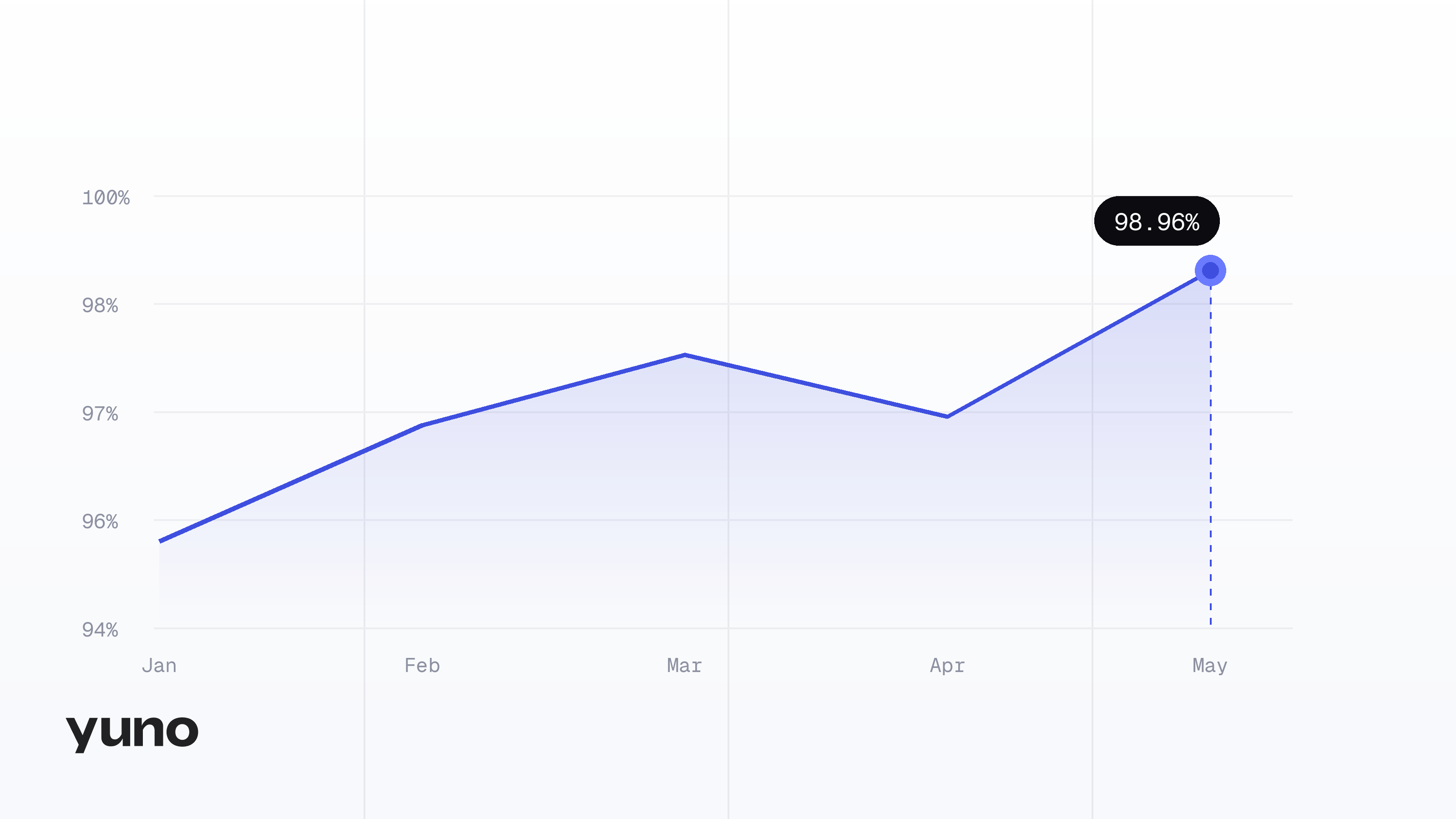
Enterprise merchants lose between 9% and 20% of annual revenue to payment failures (industry composite, 2025). Most of that loss is not inevitable. The reason it persists is that recovery tools are measured on aggregate recovery rates, not on how well they understand your specific issuer mix. That distinction is where AI in payment orchestration either earns its place or wastes yours.
This post is a direct challenge to the generic AI recovery narrative. We will show what merchant-specific decline pattern learning actually requires, why pooled-model tools hit a structural ceiling, and how the recovery math changes when the intelligence is specific to your card portfolio, your PSP stack, and your customer geography.
Key Takeaways
- Generic AI recovery tools train on pooled merchant data, which averages out the issuer behavior specific to your card mix and geography.
- Merchant-specific decline pattern learning classifies failures at the issuer level, not the decline-code level, which changes which retry path recovers the transaction.
- Multi-PSP orchestration is a prerequisite for AI recovery: a single-PSP model has no alternative route to try, regardless of how intelligent the retry logic is.
- NOVA recovers up to 75% of failed transactions by combining multi-PSP fallback routing with direct customer engagement in 70+ languages (Yuno product data, 2026).
- Recovery tools should be evaluated on issuer-level specificity, not headline recovery rates built on a different merchant's decline mix.
Why Generic AI Recovery Hits a Structural Ceiling
Generic AI recovery tools apply machine learning trained on aggregate transaction data across many merchants, which means the model reflects average issuer behavior rather than your issuer behavior. That averaging is not a minor limitation. It is the primary reason headline recovery rates in vendor decks rarely survive contact with a specific merchant's decline mix.
Here is what that looks like in practice. A large travel marketplace with a heavy UK and German card mix has different soft-decline patterns than a US-focused subscription SaaS. The Do Not Honor codes that come back from UK issuers on a Friday afternoon do not behave the same way as those from US issuers on the 1st of the month. A model trained on pooled data will apply an average retry window to both. The UK merchant loses recoverable transactions to mistimed retries. The model still reports a 70% recovery rate because the other merchants in the training pool brought that number up.
We have seen this pattern repeatedly across enterprise integrations. The merchants most frustrated by generic AI recovery are not the ones with simple card mixes. They are the ones with sophisticated issuer relationships and multi-geography card portfolios, where the average is the furthest thing from their reality.
What Merchant-Specific Decline Pattern Learning Actually Requires
Merchant-specific decline pattern learning means the model is trained on, and continuously updated by, the transaction outcomes of your card mix, your PSP stack, and your customer geography. It is not a feature flag. It is an architectural requirement that most point solutions cannot meet.
Three conditions must be true simultaneously for merchant-specific learning to function. First, the system needs access to granular decline data at the issuer level, not just the decline code level. A code 05 Do Not Honor from a major UK issuer behaves differently from a code 05 from a regional German bank. The model needs to know which issuer sent which code, in which geography, at which time of day, and on which card type. Second, the system needs enough transaction volume per issuer to build statistically reliable retry windows. A merchant processing 10,000 transactions per month across 20 issuers has 500 data points per issuer. That is not enough. An orchestration layer aggregating data across thousands of merchants can supplement the gap, but only if the model is then fine-tuned per merchant, not run as a global average. Third, the system needs multiple PSP paths to actually execute what the model recommends. A retry recommendation that routes through the same PSP that just declined the transaction is not recovery. It is a replay.
That third condition is the one most often missing from generic AI recovery tools. They are built on single-PSP infrastructure, which means the intelligence layer has nowhere to route its recommendations except back into the same acquirer. The ceiling on recovery is not the AI. It is the architecture underneath it.
How AI in Payment Orchestration Changes the Recovery Math
AI in payment orchestration breaks the single-PSP ceiling by giving the recovery model multiple routing paths and real-time issuer feedback across all of them. When a transaction fails through one acquirer, the orchestration layer can reroute the retry through a different provider with a different issuer relationship, different interchange economics, and a different probability of approval for that card type.
Yuno's platform data shows that 8% of failed transactions are recovered through fallback routing alone, before any customer contact layer is applied (Yuno platform data, 2026). That number compounds when combined with merchant-specific issuer learning, because the fallback routing decision is informed by which PSP historically approves that issuer's cards in that geography, not by a generic routing table.
The recovery math shifts further when the model can distinguish between three failure categories that generic tools routinely conflate.
- Card-side failures the customer can resolve, such as expired cards or updated account details.
- Soft declines the PSP can retry with better timing or a different acquirer, such as temporary authorization holds.
- Hard declines that are terminal and should not be retried, such as stolen card or permanently closed account codes.
Generic tools often retry terminal declines because the model cannot distinguish between a soft and hard failure at the issuer level. That creates a compounding problem: the merchant incurs network penalty fees for retrying hard declines, while simultaneously under-recovering on soft declines that were retriable. The net effect is that the recovery tool costs more than it recovers in a meaningful subset of enterprise portfolios.
What NOVA Does Differently
NOVA is Yuno's AI payment recovery agent, built on top of multi-PSP orchestration infrastructure, which means every recovery recommendation has a viable routing path to execute it. It operates across two distinct recovery modes that most generic tools handle separately, if at all.
The first mode is automated fallback routing. When a transaction fails, NOVA classifies the decline against the merchant's historical issuer patterns and reroutes through the PSP most likely to approve, based on that card type's performance history across Yuno's network. This is not a static routing table. The model updates continuously as new outcomes come in, so the routing recommendations for a UK Visa card through a mid-size European acquirer improve over time as more transaction outcomes are recorded.
The second mode is direct customer engagement. When the failure is card-side, automated routing cannot recover it because the card itself needs to be updated. NOVA contacts the customer via WhatsApp or AI-powered voice call in 70+ languages, across 200+ countries, and guides them through completing the transaction. This is where the distinction between a payment recovery tool and a retry engine becomes most visible. A retry engine reschedules the same failed attempt. NOVA changes the conditions that caused the failure.
An aviation operator using NOVA recovered 75% of contacted customers and more than $300 per transaction, with zero manual effort and zero integration cost (Yuno product data, 2026). That result is not achievable with retry logic alone, because the failures in that vertical often involve card-side issues that only the customer can resolve. The AI layer has to reach the customer before the window closes, which means the engagement needs to be immediate, personalized, and in the customer's language.
You can read more about how NOVA's approach compares to standard retry logic in our post on why multi-PSP recovery outperforms single-acquirer retry logic.
What Heads of Payments Should Demand From Any AI Recovery Tool
The right evaluation framework for AI payment recovery is built on issuer-level specificity, not headline recovery rates. A vendor reporting 70% recovery on their aggregate book tells you nothing about what they will recover on your issuer mix.
Before committing to any recovery tool, heads of payments should press on five questions.
- Is the model trained on your transactions specifically, or on a pooled dataset where your issuer patterns are averaged out with unrelated merchants?
- How does the tool distinguish between soft declines, hard declines, and card-side failures? Can it show you the classification logic per decline code and per issuer?
- What happens when the recommended retry path is through a different PSP? Does the tool have access to multiple acquirers, or does it reroute into the same single provider?
- How does the vendor measure recovery rate: as a percentage of failed transactions attempted, or as a percentage of total failed transactions including those the tool did not touch?
- What is the penalty fee exposure if the tool retries a hard decline? Who absorbs that cost?
Most generic AI recovery tools cannot answer questions two through five with specificity. They can answer question one, but the answer is pooled data. That is a meaningful gap for any enterprise merchant with a complex issuer mix.
The broader question of how to measure recovery performance, not just how to select a tool, is worth examining separately. Our post on how to actually measure failed payment recovery covers the metrics that surface the gap between what a tool claims and what it delivers on your portfolio.
The Operational Advantage of Recovery Built Into Orchestration
When AI recovery is built into the orchestration layer rather than bolted on as a separate tool, the intelligence has access to the full transaction context: PSP performance, issuer history, routing economics, and real-time approval signals across all connected providers. A standalone recovery tool sees only what it is handed, which is usually a failed transaction ID and a decline code.
From our work across enterprise merchants in financial services, travel, and digital goods, the operational gap between these two architectures surfaces fastest in three scenarios. The first is multi-geography portfolios, where a single merchant has issuers in five or more countries with different retry tolerance windows. The second is high-value low-frequency transactions, such as annual subscriptions or large marketplace disbursements, where a single failed recovery is disproportionately costly. The third is merchants switching PSPs or adding a new acquirer, where historic issuer-routing data needs to transfer cleanly rather than restart from zero.
Yuno's orchestration layer maintains issuer-routing intelligence at the platform level. When a merchant adds a new PSP, the model already has context on how that provider performs against the merchant's issuer mix, because Yuno has seen that PSP's approval patterns across comparable portfolios. The recovery intelligence does not reset. It extends.
For heads of payments evaluating where AI in payment orchestration fits their recovery stack, the starting point is a clear view of where current recovery is failing: which decline codes, which issuers, and which geographies are generating the most unrecovered revenue. That diagnostic shapes both the tool selection and the routing configuration. If the gap is in soft declines with retriable issuers, automated fallback routing closes most of it. If the gap is in card-side failures with high-value customers, direct engagement is where the recovery math changes materially.
Our broader analysis of how AI-driven recovery differs from retry logic covers both failure categories and the infrastructure requirements for each: best platform for failed payment recovery.
The Practical Takeaway
The question heads of payments should be asking is not "does this tool use AI?" Every recovery vendor makes that claim now. The question is: does the intelligence apply to my issuer mix, or to someone else's average?
Merchant-specific decline pattern learning changes the recovery math because it stops treating your portfolio like a representative sample of the market. Your UK Visa declines are not the same as a US subscription SaaS merchant's UK Visa declines. Your German issuer behavior on the last day of the month is not average behavior. The recovery model needs to know the difference.
Start with a diagnostic: pull your last 90 days of failed transactions, segment by decline code and issuer country, and identify the top five issuer-code combinations by volume. Then ask your current recovery tool to show you its retry performance against each of those combinations specifically. If the answer is an aggregate recovery rate, you have your answer about how specific the intelligence actually is.
NOVA is available on Yuno's AI payment recovery product page. The platform connects 1,000+ payment methods across 200+ countries, and NOVA operates on top of that infrastructure with zero engineering overhead required to activate it.